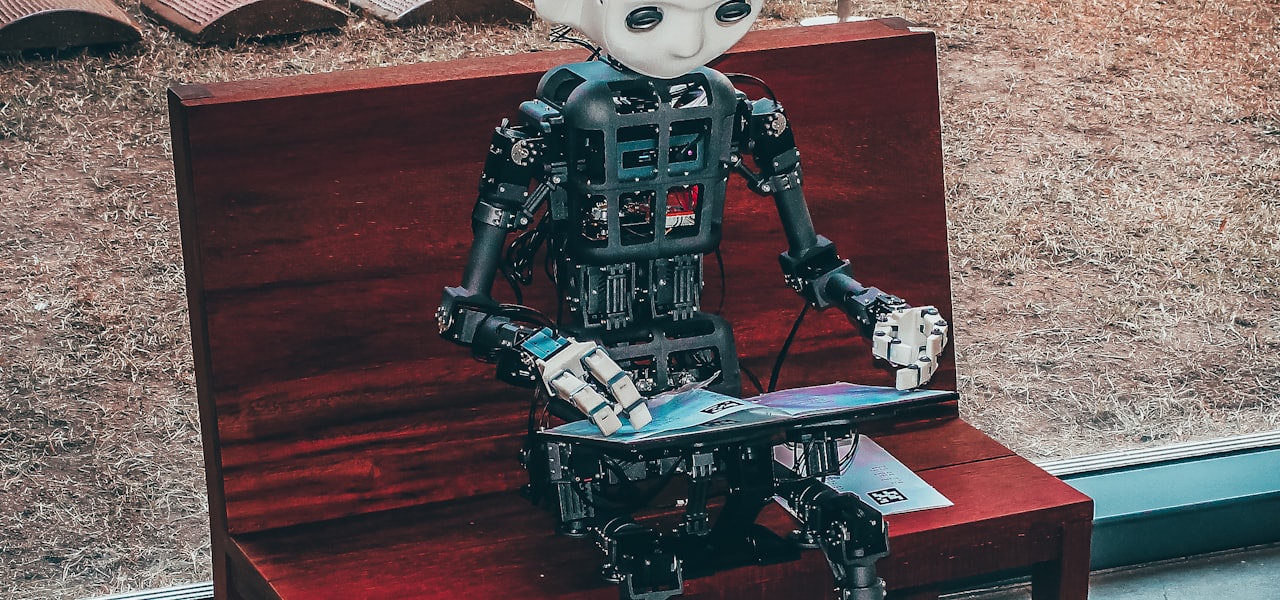
How Data Happened: A History from the Age of Reason to the Age of Algorithms is a 2023 non-fiction book written by Columbia University professors Chris Wiggins and Matthew L. Jones. The book explores the history of data and statistics from the end of the 18th century to the present day. == Content == The book starts at the end of the 18th century, when European states began tabulating physical resources, and ends at the present day, when algorithms manipulate our personal information as a commodity. It looks at the rise of data and statistics, and how early statistical methods were used to justify eugenics, quantify supposed racial differences, and develop military and industrial applications. The authors also discuss the impact of the internet and e-commerce on data collection, the rise of data science, and the consequences of government-run surveillance systems collecting vast amounts of personal data for customized, targeted advertising. They emphasize the importance of privacy and democracy and propose remedies to the problems caused by mass data collection, including stronger regulation of the tech industry and collective action by its employees. The book is a historical analysis that provides context for understanding the debates surrounding data and its control. The book has 336 pages and was published in 2023 by W. W. Norton & Company.
Automatic acquisition of lexicon
Automatic acquisition of lexicon is a computerized process used for the development of a complex morphological lexicon of a language. The lexicon is essential for the NLP (Natural language processing), as well as a prerequisite to any wide-coverage parser. The two main requirements represent raw corpus and the morphological description of the language. The aim is to provide lemmas that will serve to the explanation of all the words that occur within the corpus. For the achievement of a quality lexicon it is necessary to manually validate the generated lemmas and iterate the whole process several times. The process is focused on the open word classes (e.g. nouns, adjectives, verbs). Closed classes (e.g. prepositions, pronouns, numerals) are excluded. This method is applicable to the languages with a rich morphology, such as Slovak, Russian or Croatian. Applied to Slovak, being an inflectional language, the automatic acquisition focuses on the inflectional morphology as well as on the derivational morphology. This fact enables the users to find out the information about derivational relations (e.g. adjectivizations, prefixes) in the lexicon. For example, Slovak word korpusový is an adjectivization of korpus (eng. corpus). == Three-step loop == Conformably to Benoît Sagot, there are three stages involved in the acquisition of lemmas: Generation and inflection Ranking Manual validation The more iteration will be performed, the more accurate lexicon will be obtained. For each iteration are essential the information given by a manual validator. === Generation and inflection === Firstly, all words which represent the closed word classes (pronouns, prepositions, numerals) are manually excluded from the given corpus. Number of their occurrences in the corpus is provided. Then the automatic generation comes, when the hypothetical lemmas according to the morphological description of a language are created. Generated lemmas are consequently being inflected, so that all of their inflected forms are built. Obtained forms are associated with the corresponding lemma and a morphological tag. === Ranking === There was created a probabilistic model, represented by a fix-point algorithm, to rank the hypothetical lemmas generated in the first step. Best ranked lemmas are expected to be ideally all correct, whereas the least ranked tend to be incorrect. === Manual validation === Correctness of the best- ranked lemmas created in the previous step are checked by the manual validator, who should be a native speaker. Lemmas are at this stage divided into three categories: valid lemmas, appended to lexicon erroneous lemmas generated by valid forms (later associated to another lemmas) erroneous lemmas generated by invalid forms (these need to be excluded) == Future development == Automatic acquisition, in comparison to a purely manual development of the lexicons, seems to be promising, considering the future development, because of the short validation time needed and the relatively small amount of human labor involved.
Point distribution model
The point distribution model is a model for representing the mean geometry of a shape and some statistical modes of geometric variation inferred from a training set of shapes. == Background == The point distribution model concept has been developed by Cootes, Taylor et al. and became a standard in computer vision for the statistical study of shape and for segmentation of medical images where shape priors really help interpretation of noisy and low-contrasted pixels/voxels. The latter point leads to active shape models (ASM) and active appearance models (AAM). Point distribution models rely on landmark points. A landmark is an annotating point posed by an anatomist onto a given locus for every shape instance across the training set population. For instance, the same landmark will designate the tip of the index finger in a training set of 2D hands outlines. Principal component analysis (PCA), for instance, is a relevant tool for studying correlations of movement between groups of landmarks among the training set population. Typically, it might detect that all the landmarks located along the same finger move exactly together across the training set examples showing different finger spacing for a flat-posed hands collection. == Details == First, a set of training images are manually landmarked with enough corresponding landmarks to sufficiently approximate the geometry of the original shapes. These landmarks are aligned using the generalized procrustes analysis, which minimizes the least squared error between the points. k {\displaystyle k} aligned landmarks in two dimensions are given as X = ( x 1 , y 1 , … , x k , y k ) {\displaystyle \mathbf {X} =(x_{1},y_{1},\ldots ,x_{k},y_{k})} . It's important to note that each landmark i ∈ { 1 , … k } {\displaystyle i\in \lbrace 1,\ldots k\rbrace } should represent the same anatomical location. For example, landmark #3, ( x 3 , y 3 ) {\displaystyle (x_{3},y_{3})} might represent the tip of the ring finger across all training images. Now the shape outlines are reduced to sequences of k {\displaystyle k} landmarks, so that a given training shape is defined as the vector X ∈ R 2 k {\displaystyle \mathbf {X} \in \mathbb {R} ^{2k}} . Assuming the scattering is gaussian in this space, PCA is used to compute normalized eigenvectors and eigenvalues of the covariance matrix across all training shapes. The matrix of the top d {\displaystyle d} eigenvectors is given as P ∈ R 2 k × d {\displaystyle \mathbf {P} \in \mathbb {R} ^{2k\times d}} , and each eigenvector describes a principal mode of variation along the set. Finally, a linear combination of the eigenvectors is used to define a new shape X ′ {\displaystyle \mathbf {X} '} , mathematically defined as: X ′ = X ¯ + P b {\displaystyle \mathbf {X} '={\overline {\mathbf {X} }}+\mathbf {P} \mathbf {b} } where X ¯ {\displaystyle {\overline {\mathbf {X} }}} is defined as the mean shape across all training images, and b {\displaystyle \mathbf {b} } is a vector of scaling values for each principal component. Therefore, by modifying the variable b {\displaystyle \mathbf {b} } an infinite number of shapes can be defined. To ensure that the new shapes are all within the variation seen in the training set, it is common to only allow each element of b {\displaystyle \mathbf {b} } to be within ± {\displaystyle \pm } 3 standard deviations, where the standard deviation of a given principal component is defined as the square root of its corresponding eigenvalue. PDM's can be extended to any arbitrary number of dimensions, but are typically used in 2D image and 3D volume applications (where each landmark point is R 2 {\displaystyle \mathbb {R} ^{2}} or R 3 {\displaystyle \mathbb {R} ^{3}} ). == Discussion == An eigenvector, interpreted in euclidean space, can be seen as a sequence of k {\displaystyle k} euclidean vectors associated to corresponding landmark and designating a compound move for the whole shape. Global nonlinear variation is usually well handled provided nonlinear variation is kept to a reasonable level. Typically, a twisting nematode worm is used as an example in the teaching of kernel PCA-based methods. Due to the PCA properties: eigenvectors are mutually orthogonal, form a basis of the training set cloud in the shape space, and cross at the 0 in this space, which represents the mean shape. Also, PCA is a traditional way of fitting a closed ellipsoid to a Gaussian cloud of points (whatever their dimension): this suggests the concept of bounded variation. The idea behind PDMs is that eigenvectors can be linearly combined to create an infinity of new shape instances that will 'look like' the one in the training set. The coefficients are bounded alike the values of the corresponding eigenvalues, so as to ensure the generated 2n/3n-dimensional dot will remain into the hyper-ellipsoidal allowed domain—allowable shape domain (ASD).
PatchMatch
PatchMatch is an algorithm used to quickly find correspondences (or matches) between small square regions (or patches) of an image. It has various applications in image editing, such as reshuffling or removing objects from images or altering their aspect ratios without cropping or noticeably stretching them. PatchMatch was first presented in a 2011 paper by researchers at Princeton University. == Algorithm == The goal of the algorithm is to find the patch correspondence by defining a nearest-neighbor field (NNF) as a function f : R 2 → R 2 {\displaystyle f:\mathbb {R} ^{2}\to \mathbb {R} ^{2}} of offsets, which is over all possible matches of patch (location of patch centers) in image A, for some distance function of two patches D {\displaystyle D} . So, for a given patch coordinate a {\displaystyle a} in image A {\displaystyle A} and its corresponding nearest neighbor b {\displaystyle b} in image B {\displaystyle B} , f ( a ) {\displaystyle f(a)} is simply b − a {\displaystyle b-a} . However, if we search for every point in image B {\displaystyle B} , the work will be too hard to complete. So the following algorithm is done in a randomized approach in order to accelerate the calculation speed. The algorithm has three main components. Initially, the nearest-neighbor field is filled with either random offsets or some prior information. Next, an iterative update process is applied to the NNF, in which good patch offsets are propagated to adjacent pixels, followed by random search in the neighborhood of the best offset found so far. Independent of these three components, the algorithm also uses a coarse-to-fine approach by building an image pyramid to obtain the better result. === Initialization === When initializing with random offsets, we use independent uniform samples across the full range of image B {\displaystyle B} . This algorithm avoids using an initial guess from the previous level of the pyramid because in this way the algorithm can avoid being trapped in local minima. === Iteration === After initialization, the algorithm attempted to perform iterative process of improving the N N F {\displaystyle NNF} . The iterations examine the offsets in scan order (from left to right, top to bottom), and each undergoes propagation followed by random search. === Propagation === We attempt to improve f ( x , y ) {\displaystyle f(x,y)} using the known offsets of f ( x − 1 , y ) {\displaystyle f(x-1,y)} and f ( x , y − 1 ) {\displaystyle f(x,y-1)} , assuming that the patch offsets are likely to be the same. That is, the algorithm will take new value for f ( x , y ) {\displaystyle f(x,y)} to be arg min ( x , y ) D ( f ( x , y ) ) , D ( f ( x − 1 , y ) ) , D ( f ( x , y − 1 ) ) {\displaystyle \arg \min \limits _{(x,y)}{D(f(x,y)),D(f(x-1,y)),D(f(x,y-1))}} . So if f ( x , y ) {\displaystyle f(x,y)} has a correct mapping and is in a coherent region R {\displaystyle R} , then all of R {\displaystyle R} below and to the right of f ( x , y ) {\displaystyle f(x,y)} will be filled with the correct mapping. Alternatively, on even iterations, the algorithm search for different direction, fill the new value to be arg min ( x , y ) { D ( f ( x , y ) ) , D ( f ( x + 1 , y ) ) , D ( f ( x , y + 1 ) ) } {\displaystyle \arg \min \limits _{(x,y)}\{D(f(x,y)),D(f(x+1,y)),D(f(x,y+1))\}} . === Random search === Let v 0 = f ( x , y ) {\displaystyle v_{0}=f(x,y)} , we attempt to improve f ( x , y ) {\displaystyle f(x,y)} by testing a sequence of candidate offsets at an exponentially decreasing distance from v 0 {\displaystyle v_{0}} u i = v 0 + w α i R i {\displaystyle u_{i}=v_{0}+w\alpha ^{i}R_{i}} where R i {\displaystyle R_{i}} is a uniform random in [ − 1 , 1 ] × [ − 1 , 1 ] {\displaystyle [-1,1]\times [-1,1]} , w {\displaystyle w} is a large window search radius which will be set to maximum picture size, and α {\displaystyle \alpha } is a fixed ratio often assigned as 1/2. This part of the algorithm allows the f ( x , y ) {\displaystyle f(x,y)} to jump out of local minimum through random process. === Halting criterion === The often used halting criterion is set the iteration times to be about 4~5. Even with low iteration, the algorithm works well.
Textual case-based reasoning
Textual case-based reasoning (TCBR) is a subtopic of case-based reasoning, in short CBR, a popular area in artificial intelligence. CBR suggests the ways to use past experiences to solve future similar problems, requiring that past experiences be structured in a form similar to attribute-value pairs. This leads to the investigation of textual descriptions for knowledge exploration whose output will be, in turn, used to solve similar problems. == Subareas == Textual case-base reasoning research has focused on: measuring similarity between textual cases mapping texts into structured case representations adapting textual cases for reuse automatically generating representations.
Cups (app)
Cups (stylized as CUPS) was a mobile app launched in New York City in April 2014. It was a mobile payment and discovery platform for independent coffee shops nearby. The app was active in more than 400 cafes in New York, San Francisco, Philadelphia, Nashville, Minneapolis and Saint Paul, and other U.S. cities. == History == Cups was founded in Israel in 2012 by Gilad Rotem and four other co-founders, who were all high school friends. The company ran a limited beta pilot in Tel Aviv and Jerusalem, featuring 80 locations, from September 2012 until September 2014. Customers received all-you-can-drink coffee at certain coffee shops in Tel Aviv for approximately $45 a month. In October 2013, the founders relocated to New York. Cups participated in the Entrepreneur's Roundtable Accelerator program and went live in New York in 2014, initially working with 50 small coffee shops in Manhattan and Brooklyn. In early 2016, the company launched 30 locations in Philadelphia in February, followed by 40 more locations in San Francisco in March. == Functionality == The Cups app gave the user a list of the nearest participating coffee shops to their current location. The app user can order a drink using the app and pay the cashier with their phone. The cashier would enter a code that entered the purchase into the app's system. The app also allowed for onboard tipping and food purchases. The company reimbursed the coffee shop and kept a portion of their sales. In early 2016, the Cups Café Network was launched, using bulk purchasing power to land discounts with service providers which would normally be reserved for larger chains. In this way, the company aimed to help its café partners compete with the larger coffee chains.
INDECT
INDECT is a research project in the area of intelligent security systems performed by several European universities since 2009 and funded by the European Union. The purpose of the project is to involve European scientists and researchers in the development of solutions to and tools for automatic threat detection through e.g. processing of CCTV camera data streams, standardization of video sequence quality for user applications, threat detection in computer networks as well as data and privacy protection. The area of research, applied methods, and techniques are described in the public deliverables which are available to the public on the project's website. Practically, all information related to the research is public. Only documents that comprise information related to financial data or information that could negatively influence the competitiveness and law enforcement capabilities of parties involved in the project are not published. This follows regulations and practices applied in EU research projects. == Application and target users == The main end-user of INDECT solutions are police forces and security services. The principle of operation of the project is detecting threats and identifying sources of threats, without monitoring and searching for particular citizens or groups of citizens. Then, the system operator (i.e. police officer) decides whether an intervention of services responsible for public security are required or not. Further investigation eventually leading to persons related to threats is performed, preserving the presumption of innocence, based on existing procedures already used by police services and prosecutors. As it can be found in the project deliverables, INDECT does not involve storage of personal data (such as names, addresses, identity document numbers, etc.). A similar, behavior-based surveillance program was SAMURAI (Suspicious and Abnormal behavior Monitoring Using a netwoRk of cAmeras & sensors for sItuation awareness enhancement). == Expected results == The main expected results of the INDECT project are: Trial of intelligent analysis of video and audio data for threat detection in urban environments Creation of tools and technology for privacy and data protection during storage and transmission of information using quantum cryptography and new methods of digital watermarking Performing computer-aided detection of threats and targeted crimes in Internet resources with privacy-protecting solutions Construction of a search engine for rapid semantic search based on watermarking of content related to child pornography and human organ trafficking Implementation of a distributed computer system that is capable of effective intelligent processing == Controversy == Some media and other sources accuse INDECT of privacy abuse, collecting personal data, and keeping information from the public. Consequently, these issues have been commented and discussed by some Members of the European Parliament. As seen in the project's documentation, INDECT does not involve mobile phone tracking or call interception. The rumors about testing INDECT during 2012 UEFA European Football Championship also turned out to be false. The mid-term review of the Seventh Framework Programme to the European Parliament strongly urges the European Commission to immediately make all documents available and to define a clear and strict mandate for the research goal, the application, and the end users of INDECT, and stresses a thorough investigation of the possible impact on fundamental rights. Nevertheless, according to Mr. Paweł Kowal, MEP, the project had the ethical review on 15 March 2011 in Brussels with the participation of ethics experts from Austria, France, Netherlands, Germany and Great Britain.